Distillation remains the workhorse separation technology across chemical, pharmaceutical, and petrochemical manufacturing, but it is also one of the most energy-intensive unit operations in any process plant. Conventional distillation columns can account for a significant share of a facility's total energy bill, which is why process intensification has moved from an academic concept to a commercial necessity. For plant engineers and process development teams, the question is no longer whether to intensify distillation, but which intensification strategy fits a given separation, and what that choice demands from the equipment supporting it.
What Process Intensification Actually Means for Distillation
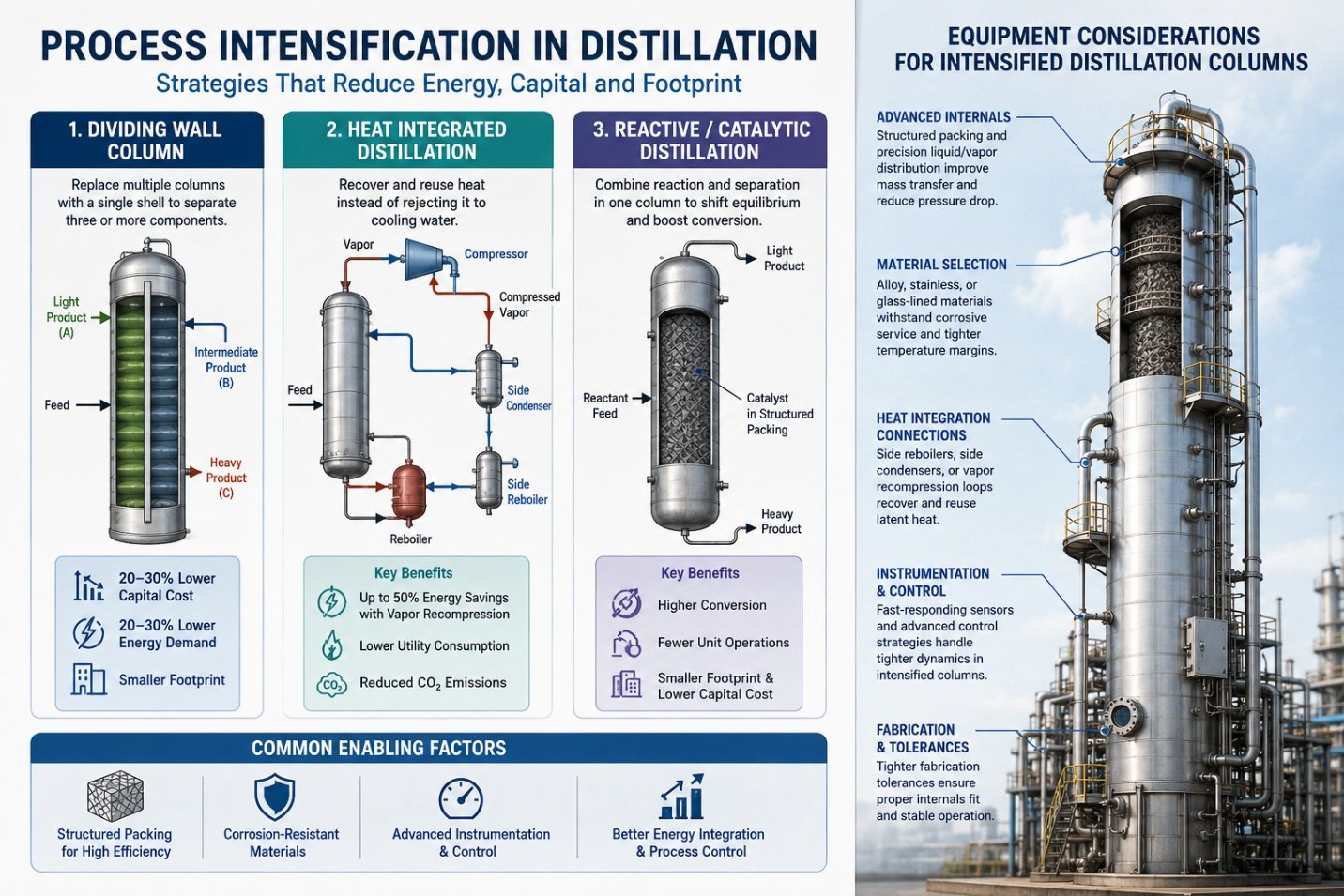
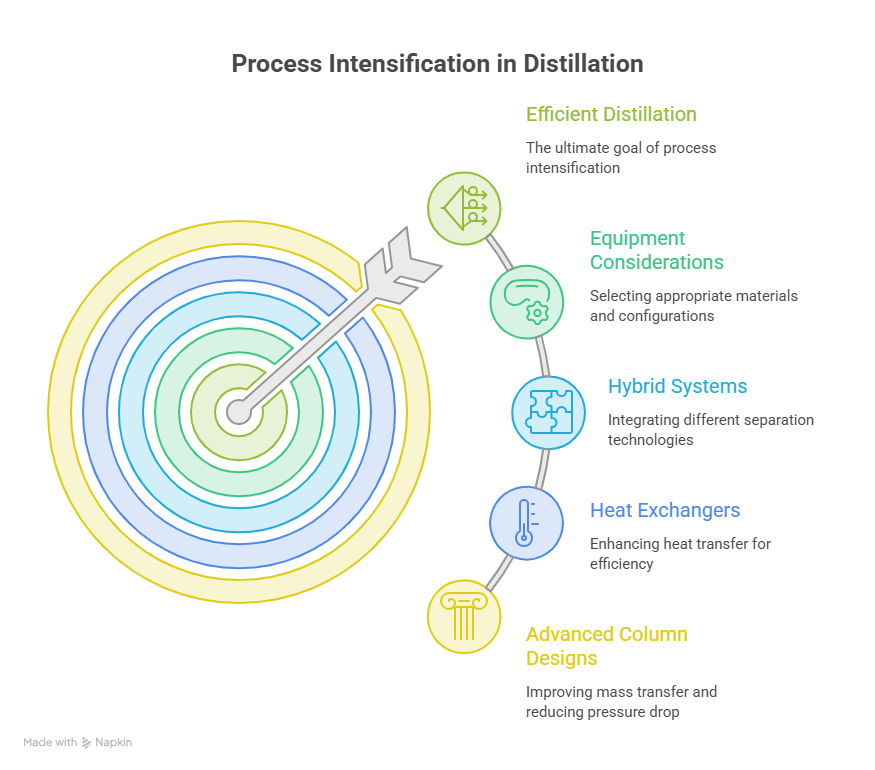
Process intensification, in the distillation context, refers to any approach that reduces the equipment footprint, energy consumption, or capital cost of a separation while maintaining or improving product quality. This is achieved by combining functions that would traditionally require separate unit operations, by improving mass and heat transfer efficiency within a single column, or by recovering energy that would otherwise be lost to cooling water or the atmosphere. The result is a smaller, more efficient plant that delivers the same separation performance with a fraction of the utility consumption.
Three strategies dominate industrial practice today: dividing wall columns, heat-integrated distillation, and reactive or catalytic distillation. Each addresses a different inefficiency in conventional column design, and each places distinct demands on internals, materials, and instrumentation.
Dividing Wall Columns for Multi-Component Separations
Where a process requires separating three or more components, conventional practice uses a sequence of two or more columns in series. A dividing wall column replaces that sequence with a single shell containing a vertical partition, allowing two effective separations to occur within one piece of equipment. This single change typically cuts both capital cost and energy demand by twenty to thirty percent compared with a conventional column train, because the thermodynamic inefficiency of remixing intermediate-boiling components is largely eliminated.
The engineering challenge lies in internals design. Liquid and vapor distribution across the dividing wall must be tightly controlled, which usually means structured packing rather than trays, along with redundant liquid distributors on either side of the partition. Column shell fabrication tolerances become tighter as well, since any asymmetry in the wall position can unbalance the split between the two sides. For teams evaluating a retrofit, the column diameter and wall material compatibility with existing nozzle locations are usually the first checks worth running.
Heat Integration and Vapor Recompression
A large share of the energy used in distillation goes into boiling liquid at the reboiler and is then thrown away as the condenser cools the overhead vapor. Heat-integrated distillation captures and reuses that latent heat instead of discarding it. The two most common approaches are mechanical vapor recompression, where overhead vapor is compressed to a higher pressure and temperature so it can supply heat to the reboiler, and the use of intermediate side reboilers and side condensers that exchange heat between trays at similar temperatures rather than only at the column ends.
Vapor recompression delivers the largest energy savings, sometimes exceeding fifty percent versus a conventional column, but it requires a compressor sized for vapor duty, additional rotating equipment maintenance, and careful control system design to manage the interaction between compression ratio and column pressure. Side heat exchangers are less dramatic in savings but considerably simpler to retrofit onto an existing column, since they typically draw a liquid or vapor side stream rather than reworking the column's primary pressure boundary.
Reactive and Catalytic Distillation
Where the separation involves a chemical reaction, such as esterification or etherification, combining reaction and separation in a single column eliminates an entire reactor and its associated heat exchangers. Catalytic distillation packing holds catalyst within structured packing elements, allowing reaction to proceed as vapor and liquid contact across the column while the lighter product is continuously removed overhead. This shifts the reaction equilibrium toward higher conversion than a standalone reactor could achieve, while simultaneously reducing the plant's overall equipment count.
The trade-off is operational flexibility. A catalytic distillation column is harder to turn down or shut down quickly than a separate reactor and column, and catalyst replacement requires a planned outage rather than the simpler swap possible in a packed-bed reactor. These columns also demand closer attention to internals material selection, since the catalyst packing must tolerate both the chemical environment and the thermal cycling of startup and shutdown.
Equipment and Materials Implications
Whichever intensification route a process team selects, the column internals, shell materials, and instrumentation all need re-evaluation rather than simple carryover from conventional design. Structured packing generally outperforms trays in intensified columns because it offers lower pressure drop and a larger surface area per unit volume, both of which matter more when energy efficiency is the goal. Glass-lined or alloy-clad vessels are often preferred for corrosive or high-purity duties, since intensified columns frequently run at higher loadings and tighter temperature margins than their conventional counterparts, leaving less tolerance for material degradation over the equipment's service life.
Instrumentation also needs to keep pace. Tighter heat integration means disturbances propagate faster through the system, so control loops for reboiler duty, reflux ratio, and compressor speed need shorter response times and, in many cases, model-based control rather than simple PID loops tuned for a conventional column.
Making the Decision
There is no universal answer to which intensification strategy suits a given separation. Dividing wall columns make the most sense for ternary or near-ternary separations with comparable product values on each side. Vapor recompression earns its premium where energy costs are high and the temperature difference between overhead and bottoms is modest enough for practical compression ratios. Reactive distillation is worth pursuing wherever conversion is limited by equilibrium and a suitable catalyst can be packaged into structured internals.
For process development and engineering teams evaluating a new or existing column, the practical starting point is a rigorous simulation of the base case alongside each intensification option, followed by a sensitivity check on utility pricing and feed variability. The equipment decisions that follow, from internals type to shell material to instrumentation philosophy, should be sized around the intensified case from day one rather than retrofitted onto a conventional design after the fact. Equipment partners who can advise on internals selection, material compatibility, and fabrication tolerances early in this process consistently help shorten the path from concept to a working, energy-efficient column.