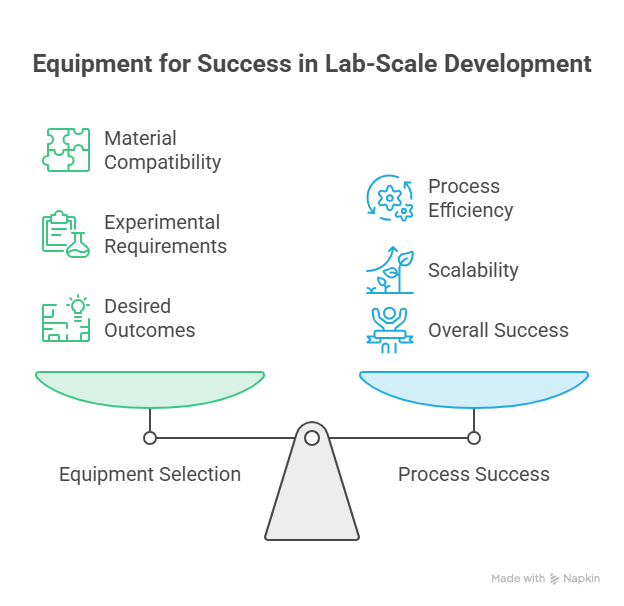
The equipment choices made on the lab bench rarely stay confined to the lab bench. Decisions about reactor type, agitation, heat transfer, and materials of construction made during early process development quietly shape what is achievable at pilot and commercial scale years later. Yet lab-scale equipment selection is frequently treated as a convenience decision, driven by whatever glassware or skid happens to be available, rather than as the first step in a scale-up strategy. For process development teams, getting this selection right early avoids costly redesign and repeated scale-up failures down the line.
Start With the Chemistry, Not the Catalogue
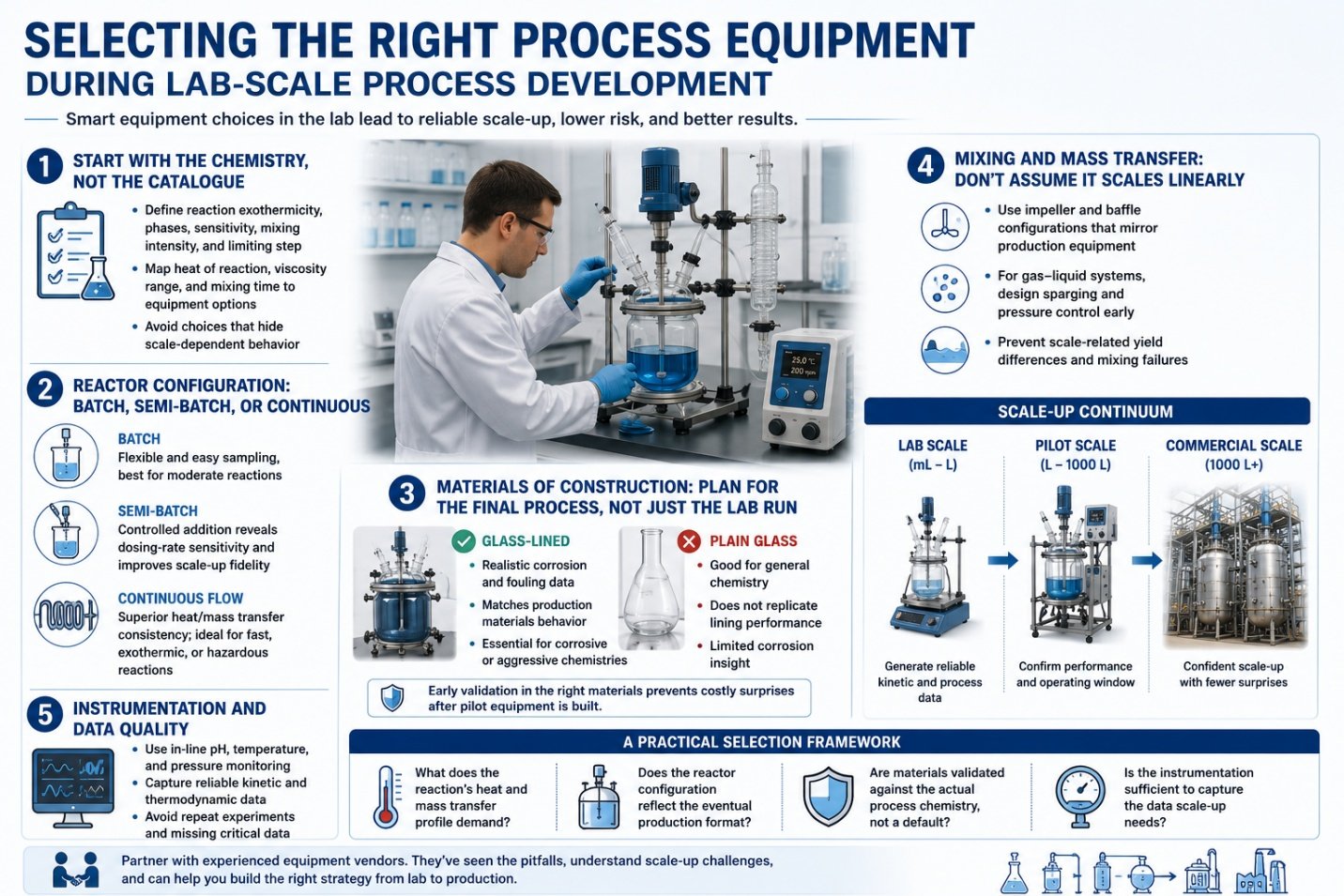
The most common mistake in lab equipment selection is choosing equipment based on availability rather than reaction requirements. Before specifying a reactor, a process development team should have clear answers on reaction exothermicity, the phases involved, sensitivity to oxygen or moisture, required mixing intensity, and whether the reaction is mass-transfer or kinetically limited. A highly exothermic reaction in a small flask may look perfectly controlled at one hundred millilitres, simply because the surface-area-to-volume ratio at that scale dissipates heat far more efficiently than any larger vessel ever will. Selecting equipment that hides this kind of scale-dependent behaviour is one of the most expensive mistakes a development program can make, because it surfaces only after pilot-scale trials, when redesign is far more costly.
A practical discipline is to map each candidate reaction's heat of reaction, expected viscosity range, and required mixing time against the equipment options under consideration before any experiments begin. This single exercise tends to immediately rule out at least one of the options a team was otherwise considering.
Reactor Configuration: Batch, Semi-Batch, or Continuous
Glass-lined and jacketed batch reactors remain the default for early development because they are flexible and allow easy sampling, but that flexibility comes at the cost of scale-up fidelity for fast or highly exothermic reactions. Semi-batch operation, where one reagent is dosed in over time, is often the better lab-scale analogue for processes that will eventually run with controlled reagent addition at production scale, since it reveals dosing-rate sensitivity that a simple batch charge would mask.
Continuous flow reactors, including simple coil reactors and more sophisticated micro-structured devices, are increasingly used at lab scale specifically because they de-risk scale-up. A continuous reactor's heat and mass transfer characteristics change far less between lab and production scale than a stirred tank's do, since the channel or tube dimensions, rather than the overall vessel volume, govern transfer rates. For reactions with narrow operating windows or that involve hazardous intermediates, evaluating a continuous configuration at the development stage, even if production will ultimately use a different format, often produces more scale-up-relevant kinetic data than a batch flask would.
Materials of Construction: Plan for the Final Process, Not Just the Lab Run
It is tempting to default to standard borosilicate glassware for every lab trial, and for many development programs that is the right call. But where a process involves halogenated solvents, strong acids, or corrosive intermediates, lab equipment selection should anticipate the materials testing that production equipment will eventually require. Running early trials in glass-lined vessels rather than plain glass, even at small scale, gives development teams genuine data on corrosion behaviour and surface fouling that a borosilicate flask simply cannot provide, since the lining chemistry and surface characteristics differ meaningfully from glass.
This matters most for processes headed toward glass-lined commercial reactors, where the lining's resistance to specific chemical environments needs validation well before a multi-tonne vessel is fabricated. A short lab campaign in a glass-lined bench reactor, run in parallel with standard glassware trials, is inexpensive insurance against discovering a corrosion or fouling problem only after pilot-scale equipment has already been built.
Mixing and Mass Transfer: Don't Assume It Scales Linearly
Agitation that looks adequate in a one-litre flask with a small magnetic stirrer frequently fails to deliver equivalent mixing once translated to a stirred tank with a mechanical impeller, because power input per unit volume, impeller tip speed, and blend time all scale differently with vessel geometry. Where a reaction is mass-transfer limited, such as gas-liquid reactions or fast precipitations, lab equipment should use an impeller geometry and baffle configuration that at least qualitatively resembles what production equipment will use, rather than whatever stirrer happens to fit the available flask.
For gas-liquid systems specifically, sparging arrangement and headspace pressure control deserve early attention, since these variables are notoriously difficult to scale and are frequently the root cause of yield differences between lab and pilot batches that otherwise appear identical on paper.
Instrumentation and Data Quality
Lab equipment selection also determines what data a development program can actually capture. Reactors fitted with in-line pH, temperature, and pressure monitoring, even at small scale, generate the kinetic and thermodynamic data that downstream process engineers need to size production heat exchangers, agitators, and control systems. A lab campaign run without this instrumentation may produce a working chemistry, but it leaves the scale-up team reconstructing critical parameters from incomplete records, often requiring repeat experiments solely to recover data that should have been captured the first time.
A Practical Selection Framework
Before committing to lab equipment for a new process, development teams benefit from working through four questions in order: what does the reaction's heat and mass transfer profile demand, does the chosen reactor configuration represent the eventual production format closely enough to generate transferable data, are materials of construction validated against the actual process chemistry rather than a convenient default, and is the instrumentation sufficient to capture the parameters that scale-up engineering will need. Equipment vendors with experience across both laboratory and production-scale process equipment can be a valuable resource at this stage, since they often see the same scale-up pitfalls recur across different chemistries and can help a development team avoid rebuilding its equipment strategy twice.