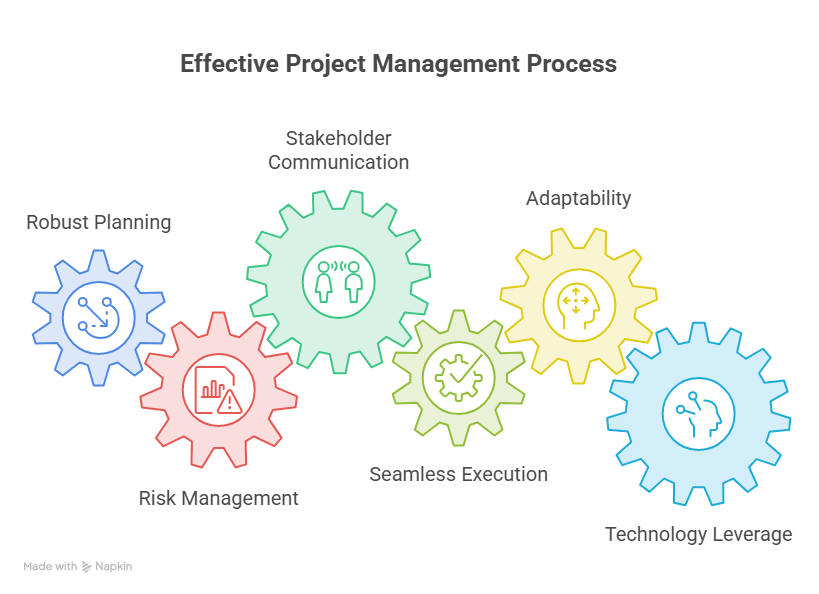
Ask any plant manager who has lived through a delayed equipment installation, and they will tell you the same thing: the technical design was rarely the problem. Engineering teams are generally good at solving engineering problems. What derails industrial equipment projects, far more often, is everything around the engineering — the coordination, the sequencing, the communication, and the discipline required to keep dozens of moving parts converging on the same delivery date. For clients evaluating an equipment supplier or EPC partner, project management capability deserves at least as much scrutiny as technical capability, because it is usually the difference between a project that finishes on schedule and one that does not.
Why Industrial Equipment Projects Are Different
A process equipment project, whether it is a single reactor or a full process skid, sits at the intersection of long lead-time fabrication, site-specific civil and utility work, regulatory and quality documentation, and a commissioning window that is often tightly constrained by a client's own production schedule. Unlike a software project, a missed fabrication milestone cannot be recovered simply by adding more people; steel takes the time it takes to form, and a glass lining takes the time it takes to cure. This means the project management function carries more weight than in many other industries, because the room for recovery once a schedule slips is genuinely limited.
Capability One: Realistic Scheduling, Not Optimistic Scheduling
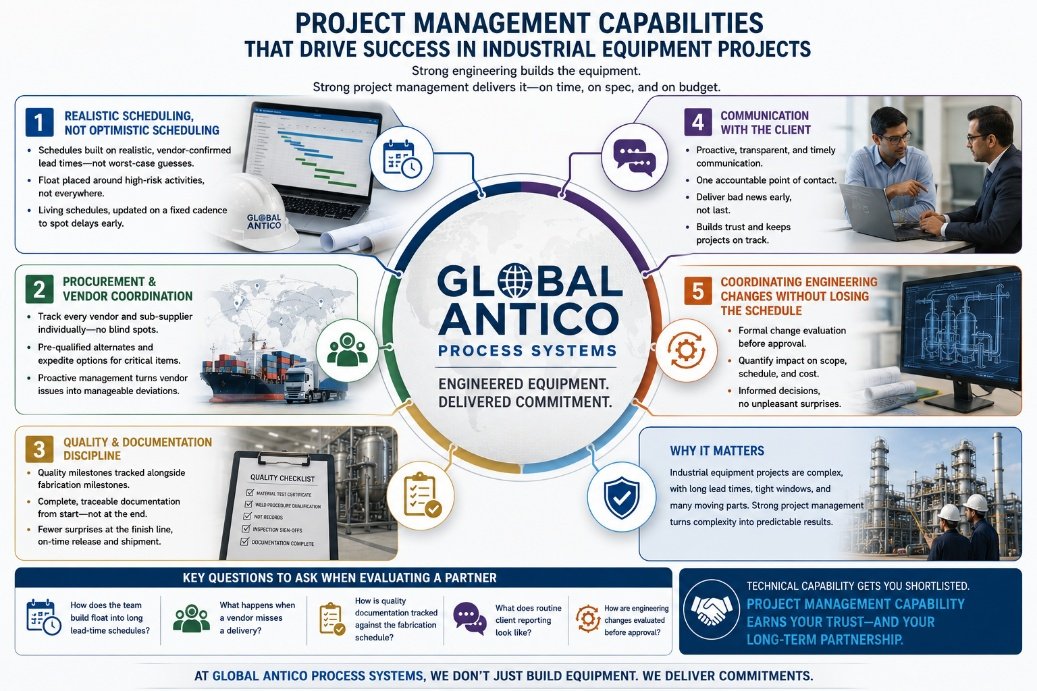
The single most common cause of project delay is a schedule built on best-case assumptions for every activity simultaneously. Long lead-time items such as forgings, glass linings, and specialty alloys have fabrication windows that do not compress under pressure, and a schedule that assumes every vendor, inspection, and approval will land on the earliest possible date is a schedule that has already failed before the project starts. Strong project management shows up as a schedule built around realistic, vendor-confirmed lead times, with float deliberately placed around the activities most likely to slip, rather than a schedule that looks impressive in a kickoff meeting and unravels by the second progress review.
Equally important is how a schedule is maintained once the project is underway. A schedule that is updated only when something has already gone wrong is not a planning tool, it is a record of damage. Capable project teams treat the schedule as a living document, updated against real progress on a fixed cadence, so that a developing delay is visible weeks before it becomes a crisis rather than discovered after the fact.
Capability Two: Procurement and Vendor Coordination
Industrial equipment projects depend on dozens of vendors and sub-suppliers, from raw material mills to instrumentation suppliers to specialty coating applicators, often spread across multiple countries with different lead times, quality systems, and shipping constraints. Effective project management means tracking each of these dependencies individually rather than treating procurement as a single line item, because a single missed sub-supplier delivery can stall an entire fabrication sequence regardless of how well every other vendor performs.
This capability is most visible in how a project team handles the inevitable vendor problem, whether that is a material certification delay, a quality non-conformance, or a shipping disruption. Teams with strong procurement discipline maintain qualified alternate suppliers for critical items and have pre-negotiated expedite options, so a single vendor issue becomes a manageable deviation rather than a project-wide emergency.
Capability Three: Quality and Documentation Discipline
Process equipment destined for regulated industries, pharmaceutical and chemical manufacturing among them, carries a documentation burden that runs in parallel with the physical fabrication work: material test certificates, weld procedure qualifications, non-destructive testing records, and inspection sign-offs that must all be complete and traceable before equipment can be released. Projects that treat documentation as an afterthought, to be assembled once fabrication is finished, routinely lose weeks at the finish line reconciling missing certificates or unresolved inspection holds.
Mature project management builds the documentation package alongside the fabrication schedule from the outset, with quality milestones tracked at the same level of rigor as physical progress milestones. This is rarely the most visible part of a project, but it is frequently the part that determines whether a piece of equipment ships on the date the schedule promised.
Capability Four: Communication With the Client
Clients rarely expect a project to run with zero surprises. What they do expect, reasonably, is to hear about a problem from their project manager before they hear about it from a missed delivery date. Project teams that communicate proactively, flagging a developing risk while there is still time to respond to it, build a level of trust that smooths over almost every other friction point in a project. Teams that communicate only when asked, or only once a problem has already become unavoidable, erode that trust regardless of how good the underlying engineering is.
This shows up in practical terms as a regular, predictable reporting cadence, a single accountable point of contact rather than a rotating cast of engineers fielding the same questions, and a willingness to deliver bad news early rather than let a client discover it independently. None of this requires sophisticated tools. It requires discipline and a genuine commitment to keeping the client informed as a default, not as a response to being asked.
Capability Five: Coordinating Engineering Changes Without Losing the Schedule
Almost every industrial equipment project encounters a design change after fabrication has started, whether driven by a client request, a site condition discovered during installation planning, or a regulatory requirement that surfaces late. How a project team absorbs that change separates strong project management from weak project management. The undisciplined response is to accommodate the change informally and hope the schedule absorbs it. The disciplined response is a formal change evaluation that quantifies the schedule and cost impact before the change is approved, so the client makes an informed decision rather than an unpleasant discovery.
This capability matters because engineering changes are not avoidable in real projects; they are a normal part of translating a design intent into a physical, fabricated, installed piece of equipment. The measure of a good project management process is not whether changes occur, but whether each one is evaluated, costed, and scheduled transparently before it is implemented.
What This Means for Evaluating a Partner
Technical capability gets a supplier shortlisted. Project management capability is usually what determines who actually wins repeat business and long-term partnerships, because it is what clients experience directly throughout the life of a project, long after the initial technical proposal has been forgotten. When evaluating an equipment supplier or EPC partner, it is worth asking pointed questions: how does the team build float into long lead-time schedules, what happens when a vendor misses a delivery, how is quality documentation tracked against the fabrication schedule, what does routine client reporting look like, and how are engineering changes evaluated before they are approved. The answers to these questions, more than any technical brochure, indicate whether a project is likely to finish on the date it was promised.