

Description
The mixing efficiency of a static mixer is quantified by the Coefficient of Variation (CoV) of the mixed stream, with values below 0.05 (5%) considered well-mixed for most process chemistry applications. The number of mixing elements required to achieve a target CoV depends on the Reynolds number, viscosity ratio, and diffusivity of the species to be mixed. For low-viscosity liquids at process flow rates, 6–12 elements typically achieve CoV < 0.01. For high-viscosity or high-density-ratio systems, 18–24 elements may be required.
For flow chemistry applications, static mixers serve as the primary mixing point for reagent addition upstream of tubular reactors and CSTRs, as quench addition mixers in downstream workup, and as heat exchange and solvent exchange contact devices. In pharmaceutical continuous manufacturing, inline static mixers are used for API precipitation, buffer preparation, and pH adjustment. Wetted materials are selected based on process chemistry: SS 316L for general organic and aqueous media; PTFE-lined or Hastelloy designs for HCl, HBr, HF, or corrosive organic streams; PEEK designs for high-temperature acidic or oxidising conditions. All designs can be equipped with injection ports, sampling nozzles, and thermowell connections.
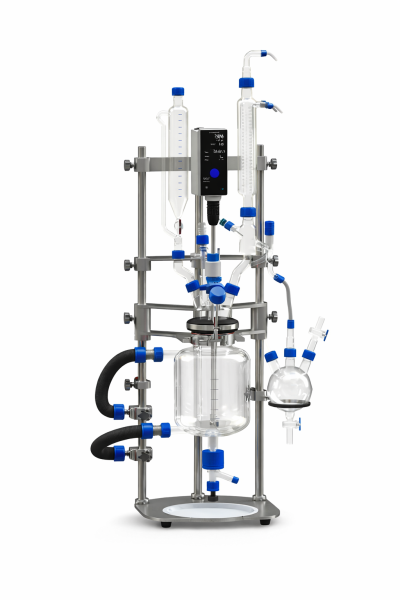
Key Features
- No moving parts — zero maintenance, zero wear, zero seals to fail
- Available in full range of corrosion-resistant alloys and polymers
- Scalable across eight decades of flow rate without design change
- Can serve simultaneously as mixer, heat exchanger, and reactor
- Plug-in replacement for standard tube / pipe sections
- Validated mixing performance with CFD and physical CoV data
- Extremely low holdup volume — ideal for precious reagent streams
- Custom element geometry for high-viscosity or multiphase duties
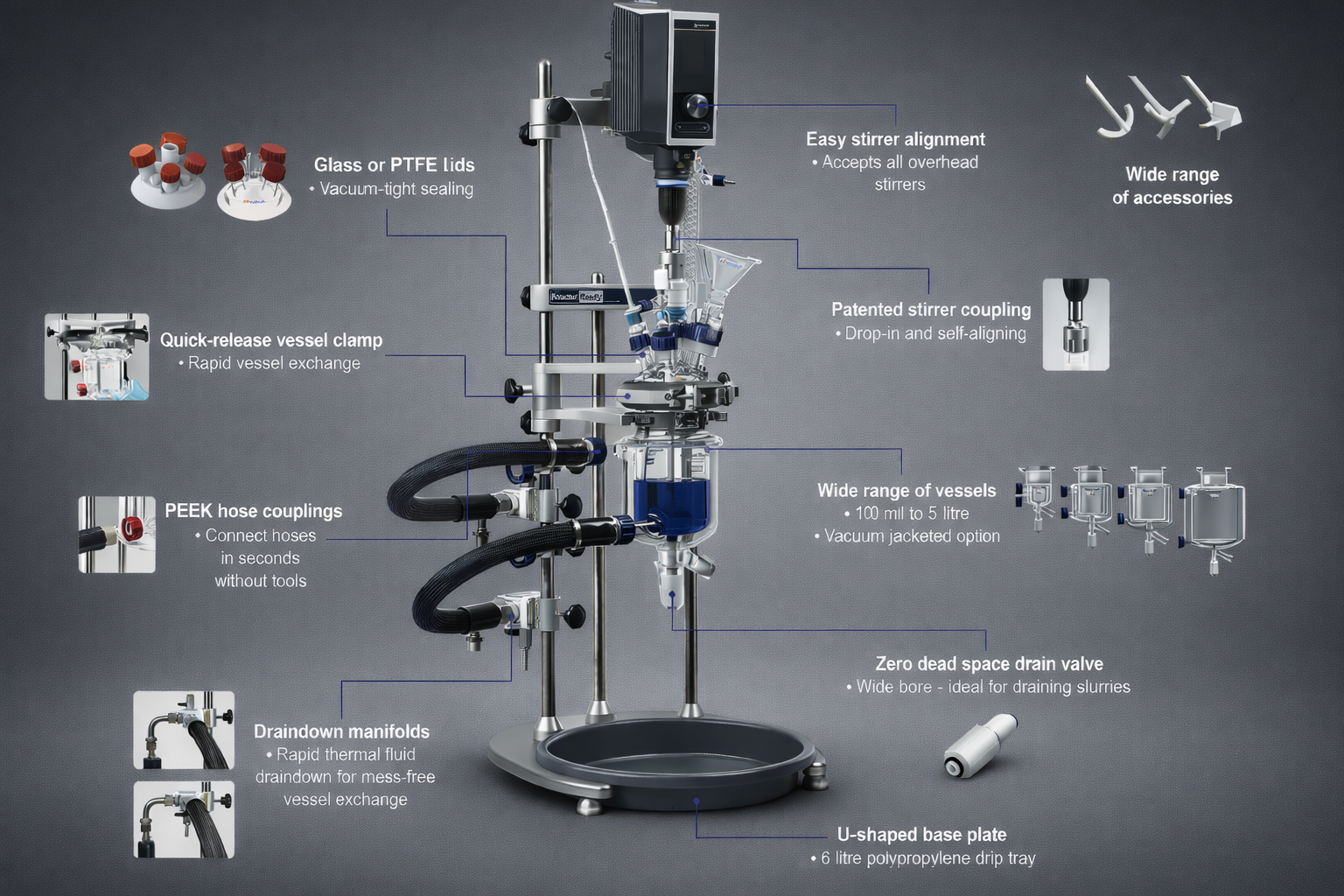
Technical Specifications
| Reactor Volume Range | 5 mL (lab) to 5,000 L (production); modular stages |
| Stage Configuration | Single CSTR to 5-stage cascade (series) standard |
| Materials of Construction | Borosilicate glass, SS 316L, Hastelloy C-276, Glass-lined CS |
| Agitation Types | Overhead mechanical, magnetic drive, PTFE-coated impeller |
| Temperature Range | −60°C to +250°C (jacketed heating/cooling) |
| Pressure Rating | Atmospheric to 10 bar (pressure-rated CSTR designs) |
| Level Control | Overflow weir, control valve, ultrasonic level sensor |
| Residence Time | 1 min to >12 hours (flow rate and volume dependent) |
| Heat Transfer | External jacket, internal coil, or both |
| Slurry Handling | Bottom discharge, baffled designs, slurry pump compatible |
Industrial Applications
- Enzymatic reactions and biocatalytic processes requiring gentle mixing
- Liquid–liquid biphasic reactions with immiscible solvents
- Crystallisation and precipitation of pharmaceutical APIs
- Polymerisation reactions where back-mixing moderates heat release
- Continuous neutralisation, saponification, and hydrolysis reactions
- Salt formation and filtration-integrated continuous processes
If you need process solution... We are available for you
Submit your reaction parameters, operating pressure, temperature range, and material compatibility requirements. Our engineering team will recommend the appropriate configuration.