

Description
The residence time distribution (RTD) of an ideal CSTR follows an exponential decay profile — meaning a fraction of the entering reagent exits immediately while some material remains for extended periods. For reactions where narrow residence time distribution is important (e.g., polymerisations or reactions sensitive to over-processing), multiple CSTRs in series are used, with the RTD of n CSTRs in series approaching plug-flow behaviour as n increases. In flow chemistry practice, 2–5 CSTRs in series are commonly used to achieve the combination of back-mixing (beneficial for highly exothermic reactions where temperature spikes must be damped) and plug-flow character.
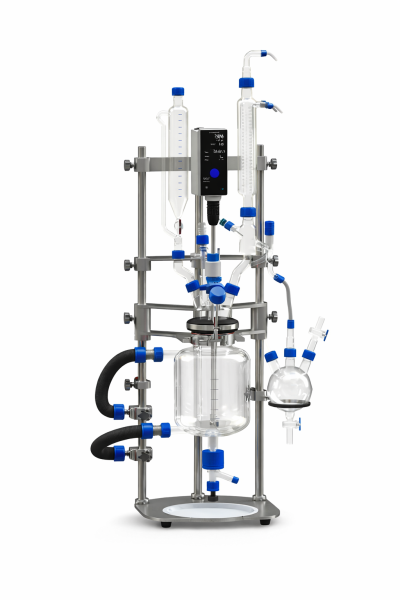
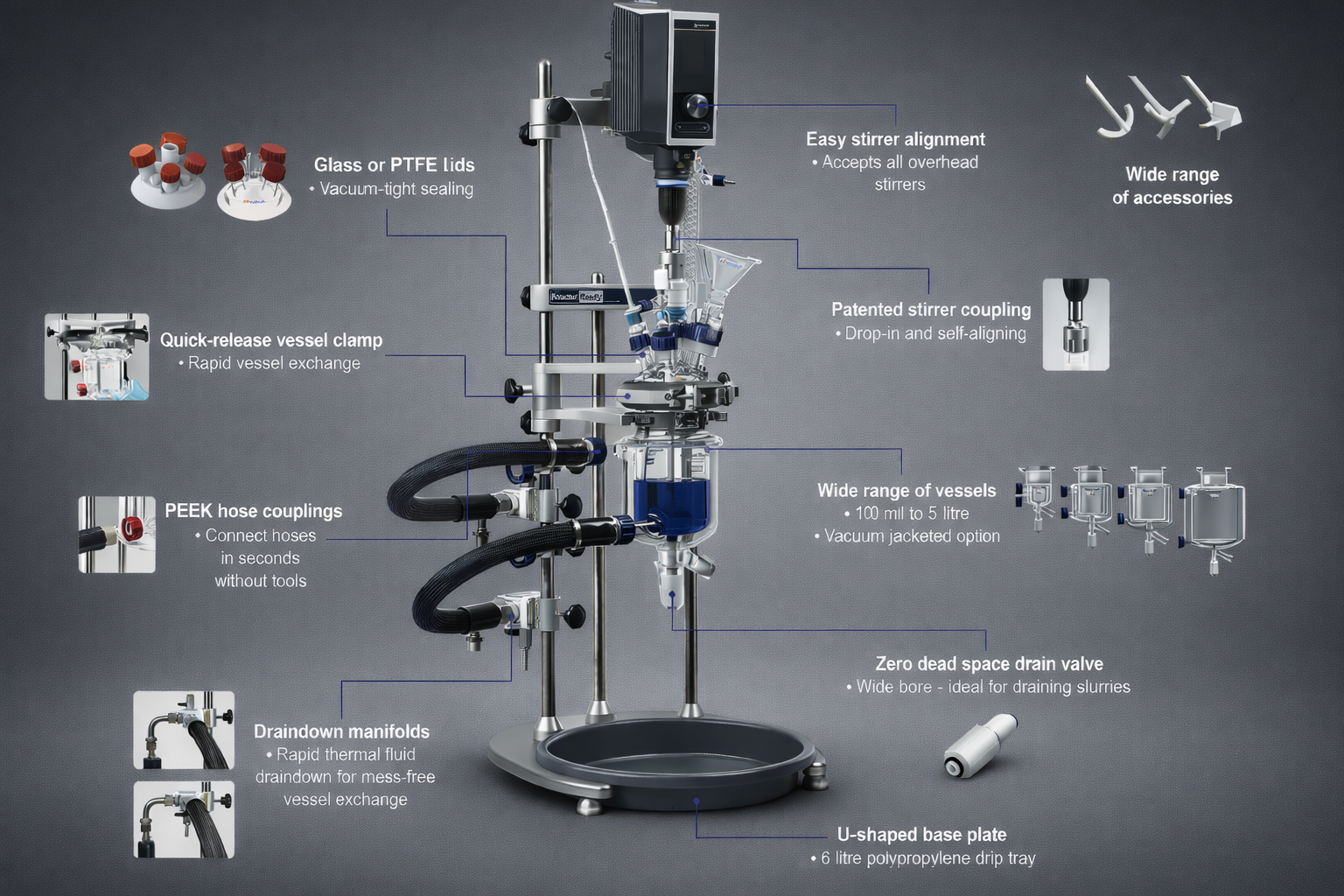
For laboratory and kilo-lab scale, CSTR units are available in glass-jacketed formats (10 mL to 5 L) with precision overhead stirring, PT-100 temperature sensing, and level control. At pilot and production scale, CSTR units in SS 316L or Hastelloy C-276 with external jacket heating/cooling, multiple reagent inlet nozzles, internal baffles, and control valve-based level and feed management are used. Magnetic coupling agitators are available for completely sealed designs required for highly toxic or air-sensitive chemistries. Slurry handling — critical for reactions producing solid products (e.g., salt formation, crystallisation) — is addressed through bottom-discharge valve designs, slurry pumps, and smooth internal geometry to prevent fouling.
Key Features
- Continuous steady-state operation with constant product quality
- Full range of agitation options including magnetically sealed drives
- Well-mixed conditions — ideal for mass-transfer-limited reactions
- Integrated jacket, coil, and baffles for full heat management
- Multi-stage cascades approach plug-flow RTD characteristics
- Slurry-compatible designs for solid-forming reactions
- Back-mixing dampens exotherms — safer than batch for fast exothermic reactions
- GMP-compatible polished designs for pharmaceutical production
Technical Specifications
| Mixing Element Types | Helical (Kenics-type), SMX corrugated plate, SMV, tab-type, multi-hole |
| Tube/Body Diameter | DN 4 mm to DN 300 mm (custom larger sizes available) |
| Materials of Construction | SS 316L, Hastelloy C-276, PTFE-lined, PEEK, Ti Gr.2 |
| Pressure Rating | Full vacuum to 250 bar (design dependent) |
| Temperature Range | −60°C to +300°C |
| Viscosity Range | 0.1 mPa·s to >100,000 mPa·s (high-viscosity elements) |
| Flow Regime | Laminar (Re < 100) to turbulent (Re > 2300) designs available |
| CoV Target | <0.05 standard; <0.01 achievable for low-viscosity systems |
| Connections | Tri-clamp, flanged, NPT, Swagelok, custom face seal |
| Inline Options | Injection ports, thermowell, sample nozzle, pressure tapping |
Industrial Applications
- Reagent addition upstream of tubular and loop reactors
- Inline pH adjustment and buffer preparation in pharmaceutical manufacturing
- Emulsification, suspension, and dispersion preparation
- Quench addition in continuous downstream workup
- Gas absorption and dissolution (CO₂, HCl, NH₃) in liquid streams
- Inline blend homogenisation for multi-component feed preparation
If you need process solution... We are available for you
Submit your reaction parameters, operating pressure, temperature range, and material compatibility requirements. Our engineering team will recommend the appropriate configuration.